Pana (Panel) Difference Chart: What You Need to Know
August 4, 2025 · By Prabhat M.
Open any panel record in the matka world and you will notice the same thing: three-digit pannas pile up fast, and after a while they start to blur together. Sorting them by hand feels endless. The Pana Difference Chart, known to many regulars as the Hanger Chart, exists to solve exactly that problem. It takes the full spread of three-digit pannas and files each one into a single tidy family, using nothing more than the gap between two of its digits. Once you see how that gap is measured, a wall of numbers turns into ten readable columns.
What a Pana Difference Actually Is
Every three-digit panna has a first, middle, and last digit. Label them A, B and C in that order. The pana difference is the gap between the first digit and the last digit only, taken as a positive number. The middle digit B plays no part in the calculation at all. In plain terms, you subtract the smaller of A and C from the larger one and keep whatever is left.
Take the panna 168. Here A is 1 and C is 8, so the difference is 8 minus 1, which equals 7. The 6 in the middle is ignored. Try another: 352 gives A as 3 and C as 2, so the difference is 3 minus 2, equal to 1. The method never changes no matter how large the digits look.
The One Rule That Catches Beginners
There is a single quirk worth memorising: in this system the digit 0 ranks above 9 and is treated as 10. So whenever a 0 sits in the first or last position, count it as 10 before subtracting. Consider 190, where A is 1 and C is 0. Because the 0 becomes 10, the difference is 10 minus 1, which lands at 9. Forget this rule and the whole grouping shifts, so it is worth pausing on until it feels natural.
A Worked Example, Start to Finish
Suppose you are reviewing a record and want to place the panna 447. Walk through it slowly:
- Identify A and C. The first digit is 4, the last digit is 7.
- Ignore the middle digit, the 4 in the centre.
- Subtract: 7 minus 4 equals 3.
- The panna 447 belongs to the Difference 3 family.
Run the same routine on 800. A is 8, C is 0, and the 0 counts as 10, so 10 minus 8 equals 2. That places 800 in the Difference 2 group. With a little practice you will start reading these gaps almost at a glance.
Why People Keep This Chart Handy
The chart does not predict anything, and no honest guide would claim it does. What it offers is structure. By collapsing hundreds of pannas into ten difference families, it lets you revisit historical panel records without drowning in detail. You can ask focused questions, such as which difference families showed up most often in a given stretch, and actually answer them. For followers of prabhat satta matka, that organised view is the real value, not any promise of a result.
The Full Pana Difference Chart
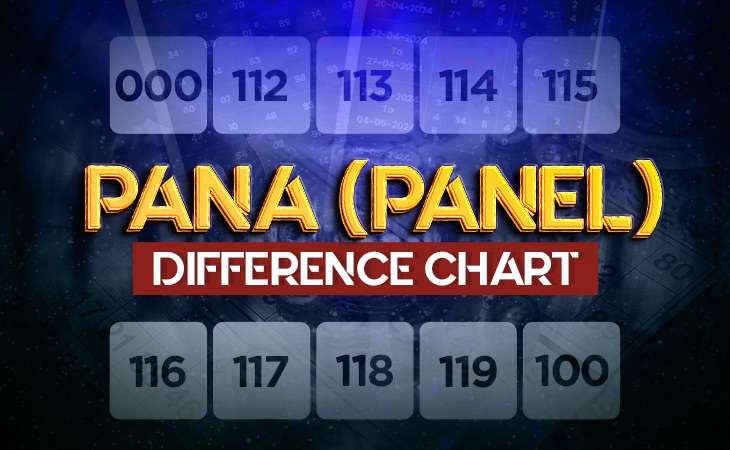
Below is every three-digit panna sorted by its difference value, from 0 through 9. This is the same reference grid experienced members keep beside them.
Difference 0
000, 111, 222, 333, 444, 555, 666, 777, 888, 999
Difference 1
112, 122, 223, 233, 334, 344, 445, 455, 556, 566, 667, 677, 778, 788, 889, 899, 900
Difference 2
113, 123, 133, 224, 234, 244, 335, 345, 355, 446, 456, 466, 557, 567, 577, 668, 678, 688, 779, 789, 799, 800, 880, 890
Difference 3
114, 124, 134, 144, 225, 235, 245, 255, 336, 346, 356, 366, 447, 457, 467, 477, 558, 568, 578, 588, 669, 679, 689, 699, 700, 770, 780, 790, 990
Difference 4
115, 125, 135, 145, 155, 226, 236, 246, 256, 266, 337, 347, 357, 367, 377, 448, 458, 468, 478, 488, 559, 569, 579, 589, 599, 600, 660, 670, 680, 690
Difference 5
116, 126, 136, 146, 156, 166, 227, 237, 247, 257, 267, 277, 338, 348, 358, 368, 378, 388, 449, 459, 469, 479, 489, 499, 500, 550, 560, 570, 580, 590
Difference 6
117, 127, 137, 147, 157, 167, 177, 228, 238, 248, 258, 268, 278, 288, 339, 349, 359, 369, 379, 389, 399, 400, 440, 450, 460, 470, 480, 490
Difference 7
118, 128, 138, 148, 158, 168, 178, 188, 229, 239, 249, 259, 269, 279, 289, 299, 300, 330, 340, 350, 360, 370, 380, 390
Difference 8
119, 129, 139, 149, 159, 169, 179, 189, 199, 200, 220, 230, 240, 250, 260, 270, 280, 290
Difference 9
100, 110, 120, 130, 140, 150, 160, 170, 180, 190
Quick Questions Players Ask
Does the middle digit ever matter for the difference?
No. The difference is calculated only from the first and last digits. The middle digit can be anything from 0 to 9 and the family stays the same.
Why is 0 treated as 10 instead of 0?
It is a convention built into this chart so that pannas ending or starting in 0 fall into the higher difference families rather than collapsing into small ones. It keeps the ten groups consistent and avoids odd overlaps.
Can this chart tell me which panna will come next?
It cannot. The chart is a sorting and study tool only. Each draw is decided by chance, and grouping past numbers does not change the odds of any future outcome.
Final Thoughts
Treat the Pana Difference Chart as a lens rather than a crystal ball. Knowing how the gap between A and C is measured, remembering the 0-as-10 rule, and using the ten families to organise past records lets you study results calmly instead of staring at chaos. The draw itself still rests on luck, but a clear method beats guesswork every time. For live results and updated charts, keep following Tiger Prabhat World.
About the author
Written by the Tiger Prabhat editorial team — players and result-watchers who have followed Prabhat and Satta Matka markets for years, bringing you fast, accurate results and clear guides.